Dead or Alive II is one of those slot games that immediately sets a different tone compared to most modern online releases. Instead of trying to keep players constantly engaged with frequent small wins, it builds its entire identity around tension, waiting, and sudden bursts of intensity. On platforms like Lucky Nugget Casino in New Zealand, it is usually placed among premium high-volatility titles because it behaves more like a risk-based experience than a casual entertainment slot.
Dead or Alive II
The structure itself looks simple at first glance. A five-reel setup with three rows and a limited number of paylines suggests an easy, almost traditional slot experience. But this simplicity hides a very different kind of design philosophy. The game is not built around constant feedback; it is built around contrast. Long stretches of quiet spins are intentionally part of the experience, because they make the moments of change feel much more powerful.
Instead of focusing on constant reward cycles, the game creates a pacing system where “nothing happening” is actually part of the design. This is why many players describe it as cinematic rather than mechanical. The base game is not where the excitement peaks; it is where anticipation is formed.
Wild West Atmosphere and Visual Direction
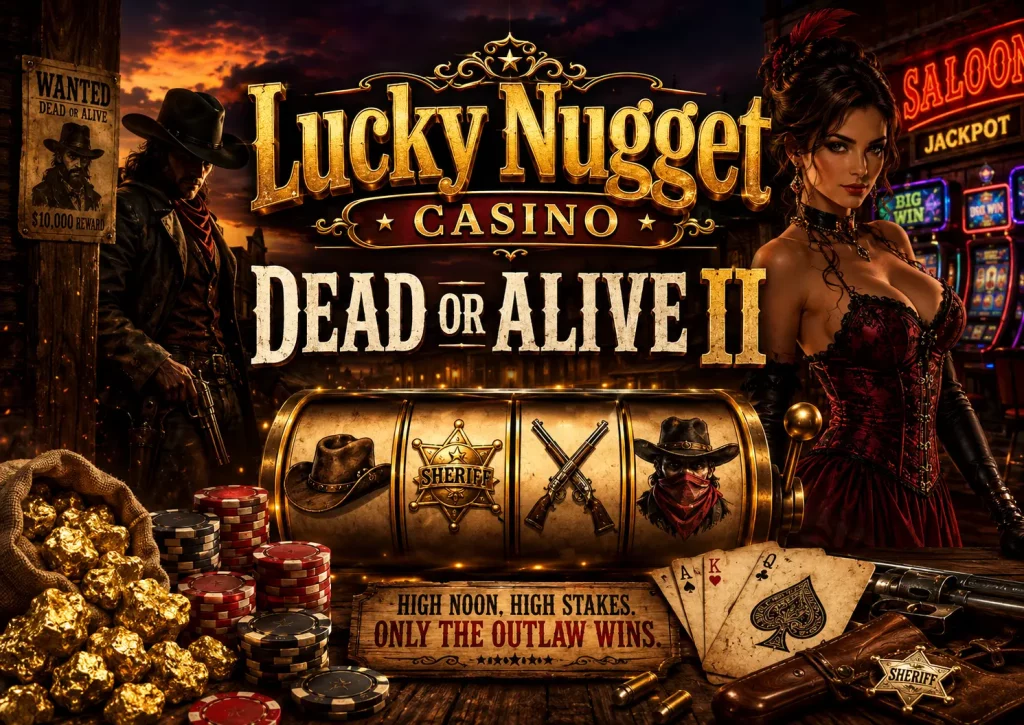
The setting is a stylised Wild West town, filled with dusty streets, wooden buildings, and outlaw characters that define the game’s visual identity. Everything is designed to feel slightly tense, almost like a standoff is always about to happen.
This atmosphere is not just decorative. It directly supports the gameplay rhythm. The quiet visual tone in the base game mirrors the slow buildup of tension in the mechanics. Even the animations are restrained, which makes any sudden change in symbols feel more dramatic.
Sound design reinforces this effect. Instead of constant high-energy music, the game uses minimal Western-style audio cues that grow more intense when special symbols begin to appear. This gradual escalation plays a psychological role, preparing the player for the possibility of a feature trigger.
Symbol Structure and Game Balance
| Symbol Tier | Examples | Role in Gameplay | Frequency |
|---|---|---|---|
| Premium Outlaws | Bandit Characters | Primary high-value wins | Rare |
| Mid Thematic Symbols | Guns, Whiskey, Boots | Moderate payouts and fills | Medium |
| Low Card Symbols | A, K, Q, J, 10 | Base game stability | High |
Bonus Mechanics as the Real Game Engine
What truly defines Dead or Alive II is not the base game, but the way it transforms during bonus features. Instead of offering a single free spin mode, the game introduces multiple bonus variations, each changing how Wild symbols behave.
Sticky Wilds can remain locked on reels for the entire feature, gradually building winning potential over time. Super Free Spins take a more explosive approach, where Wilds expand to cover entire reels. The most intense version combines both systems, creating situations where the screen can become heavily dominated by Wild symbols.
This layered approach means that no two bonus rounds feel identical. The mechanic itself becomes the main source of excitement, rather than static payout tables.
Volatility Behaviour and Player Experience
Volatility Progression (Dead or Alive II)
● Base – low volatility, minimal wins
● Low – small wins start appearing
● Mid – balanced activity phase
● Bonus – feature trigger zone
● Max – highest volatility (big win potential)
Platform Positioning on Lucky Nugget Casino
Within Lucky Nugget Casino’s game library, Dead or Alive II is typically placed among high-volatility and premium slot selections. It is not positioned as a casual entry-level game, but rather as an option for players who already understand risk-based gameplay.
Navigation through the platform often leads users through a structured flow such as Login, Sign up, Bonus, App, Games, Slots, and Links before reaching titles like this. That structure helps separate different gaming styles, ensuring that high-volatility slots are grouped together rather than mixed with low-risk entertainment games.
Bonus Features and Game Flow
If the base game of Dead or Alive II feels restrained and quiet, the bonus system is where the entire experience suddenly shifts into a different gear. This is the moment the game stops behaving like a standard slot and starts acting more like a volatility engine designed around rare but high-impact outcomes.
What makes this structure interesting is not just the payout potential, but the way it changes the rules of play depending on which feature is triggered. Instead of a single free spin mode, the game branches into multiple bonus variants, each with its own logic for Wild symbols and reel behavior.
Dead or Alive II
One version of the bonus locks Wild symbols in place for the entire round, slowly building pressure across the reels. Another version expands Wilds to cover full reels, dramatically increasing the chance of multiple line hits at once. The most intense variation combines both mechanics, creating a situation where the screen can quickly become dominated by Wilds and multipliers.
This structure is the reason the game is often described as unpredictable. Two bonus rounds can feel completely different, even though they originate from the same trigger system. The outcome depends less on frequency and more on configuration.
How Bonus Modes Change Gameplay Behavior
Rather than treating free spins as a single reward event, Dead or Alive II uses them as branching systems. Each branch modifies how value is generated during the session.
Sticky Wilds tend to build gradual momentum. Wins appear slowly, but positions on the reels become increasingly valuable over time. Super Free Spins, on the other hand, create more immediate volatility spikes, where a single spin can completely reshape the outcome of the round.
This contrast between gradual accumulation and sudden expansion is what creates the game’s emotional pacing. Players are not just waiting for wins; they are waiting for a shift in mechanics.
Bonus Mode Comparison
| Bonus Mode | Wild Behavior | Win Style | Volatility Impact |
|---|---|---|---|
| Sticky Wilds | Wilds remain locked on reels | Gradual accumulation | Medium-High |
| Super Free Spins | Wilds expand across reels | Explosive single-spin wins | Very High |
| Extra Sticky Wilds | Locked + expanding Wild mechanics | Maximum variance outcomes | Extreme |
Volatility Distribution Across Bonus Types
Gradual build-up wins
Explosive win potential
Maximum variance mode
How This Connects to Real Gameplay Experience
What this structure creates in practice is a clear separation between expectation and outcome. The base game builds anticipation without delivering frequent rewards, while the bonus system concentrates value into short, high-impact sequences.
For players on platforms like Lucky Nugget Casino, this means the experience is not about steady progression but about timing. The entire system is designed around waiting for a state change rather than grinding incremental wins.
RTP Behaviour, Volatility Strategy and Player Outcomes
At this point in the game’s structure, Dead or Alive II starts to feel less like a typical slot and more like a probability system that rewards patience over frequency. The entire design is anchored in high volatility logic, meaning outcomes are heavily uneven: long quiet stretches are not a side effect, they are part of the core architecture.
Dead or Alive II
This is where the Return to Player (RTP) profile becomes important. While the theoretical RTP sits in the mid-96% range, the practical experience depends heavily on when and how bonus features are triggered. Two players can have completely different sessions: one might experience multiple bonus rounds quickly, while another may go through extended dry cycles with minimal returns.
What defines this structure is not just randomness, but distribution. Wins are not evenly spread across time; instead, they cluster around specific high-impact states, especially during bonus modes with Wild mechanics.
RTP Reality vs Player Experience
On paper, RTP suggests long-term fairness. In practice, Dead or Alive II translates that RTP into very “lumpy” outcomes. Instead of steady returns, the game compresses value into rare spikes.
This is why bankroll management matters more here than in low-volatility slots. The game does not reward consistency in short sessions; it rewards endurance until a feature trigger changes the entire dynamic.
Player Behaviour Patterns
Across high-volatility games like this, players usually fall into three behavioural styles:
Some players treat it as a short-session game, accepting frequent losses in exchange for a chance at a large bonus hit. Others approach it more methodically, extending sessions and controlling stake size to survive long dry phases. A smaller group focuses almost entirely on bonus hunting, treating base gameplay as a transition phase rather than a source of value.
The key difference between these approaches is not strategy accuracy, but tolerance for variance.
RTP & Outcome Distribution
| Session Type | Base Game Return | Bonus Trigger Rate | Typical Outcome | Risk Level |
|---|---|---|---|---|
| Short Session | Low–Moderate | Rare | Small losses or occasional spike | High Risk |
| Medium Session | Moderate | Occasional | Balanced swings with bonus chance | Medium–High |
| Long Session | Variable | More likely over time | High variance with strong bonus impact | Very High |
How Volatility Shapes Bankroll Flow
The most important aspect of Dead or Alive II is not how often you win, but how the game distributes winning potential across time. The structure forces bankrolls to behave unevenly: small consistent losses in base gameplay are offset by rare but large upside events in bonus modes.
This creates a cycle where players experience long periods of low engagement followed by sudden spikes of activity. The emotional contrast between these states is intentional and is one of the reasons the game remains so widely played in high-volatility slot categories.
Platform Context and Navigation Flow
Within Lucky Nugget Casino, this type of game is typically accessed through structured navigation paths designed for category filtering rather than casual browsing. Players usually move through sections such as Login, Sign up, Bonus, App, Games, Slots, and Links before reaching high-volatility titles like this one.
This positioning is intentional, as it separates high-risk gameplay from casual entertainment categories and helps frame expectations before the game begins.
By the time players reach the deeper understanding of Dead or Alive II, the game stops being interpreted as a traditional slot and starts being treated as a structured volatility model. Everything ultimately revolves around timing, variance tolerance, and how long a bankroll can survive until a high-impact bonus state appears.
Unlike low-volatility slots where steady return patterns can be expected, this game is built around compressed value distribution. That means the majority of meaningful results are not found in the base game at all, but inside bonus structures where Wild mechanics reshape the entire reel layout.
At its highest level, the experience can be simplified into one core idea: the game removes predictability in exchange for rare but amplified outcomes.
Understanding the Real Win Condition
The biggest misconception about Dead or Alive II is that frequent play leads to gradual profit. In reality, the game does not reward frequency; it rewards exposure to volatility cycles.
Wins of significant size are typically not the result of accumulation, but of configuration — specifically how Wild symbols align during bonus modes. When Sticky Wilds or expanding Wilds activate in favorable positions, the payout curve changes dramatically within a very small number of spins.
This is also why bankroll pacing matters more than betting size alone. The ability to stay in the session long enough to reach bonus states is often more important than the stake per spin.
Practical Strategy Approach
Instead of treating the game as a linear win/loss system, experienced players tend to approach it as a “bonus access cycle.” The base game is not viewed as a profit zone, but as a transition phase toward feature activation.
Short sessions typically rely on luck-based bonus entry, while longer sessions are structured around endurance. Neither approach guarantees outcomes, but they define how variance is experienced.
One important detail is that increasing stake size does not increase bonus frequency. It only scales potential outcomes once the bonus is triggered. This is a key distinction that separates volatility-based slots from regular RTP-driven games.
Each bonus mode behaves differently under identical conditions. Sticky Wilds gradually increase reel density, creating cumulative value. Super Free Spins create sudden spikes where a single spin can outweigh dozens of base spins. The hybrid mode amplifies both effects simultaneously, producing the most unpredictable results.
The key point is that volatility is not constant — it escalates inside the bonus itself.
Strategy & Outcome
| Play Style | Session Length | Risk Exposure | Bonus Dependency | Expected Behavior |
|---|---|---|---|---|
Short Burst Play | Short | High | Very High | Frequent small losses, rare spikes |
Balanced Session Control | Medium | Moderate | High | Mixed variance, occasional bonus wins |
High Endurance Play | Long | Very High | Critical | High variance with strong swing potential |
Max Win Potential and Realistic Expectations
Dead or Alive II is often discussed in terms of its theoretical maximum win potential, which is extremely high compared to standard slot games. However, this potential is tightly linked to very specific bonus configurations, particularly those involving stacked Wilds in multiple reels.
In practice, reaching maximum outcomes is statistically rare and heavily dependent on bonus synergy rather than base gameplay performance. Most meaningful wins occur in mid-range bonus outcomes rather than extreme theoretical peaks.
This is an important distinction because it prevents misinterpretation of the game as a predictable high-profit system. It is not designed for consistency; it is designed for variance compression.
When viewed as a whole, Dead or Alive II is less about individual spins and more about structural probability shifts. The base game serves as a waiting phase, while the bonus system acts as the primary value generator.
This creates a rhythm where long periods of inactivity are intentionally balanced by short bursts of high-intensity gameplay. The emotional contrast between these states is a core part of the design and one of the reasons the game remains widely recognised among high-volatility slot players.
Within platforms like Lucky Nugget Casino, this title is positioned as a premium volatility experience rather than casual entertainment, and it is typically grouped with other high-risk, high-reward games in the Slots category.
Because of its volatility profile, this type of game is best approached with structured expectations. Outcomes are not linear, and variance can produce both extended loss periods and sudden wins. Understanding this cycle is more important than attempting to predict individual spins.
Dead or Alive II is ultimately defined by its imbalance: minimal base-game returns contrasted with highly amplified bonus outcomes. This imbalance is not a flaw but the foundation of its design, and it is what makes the game both unpredictable and compelling over long sessions.


